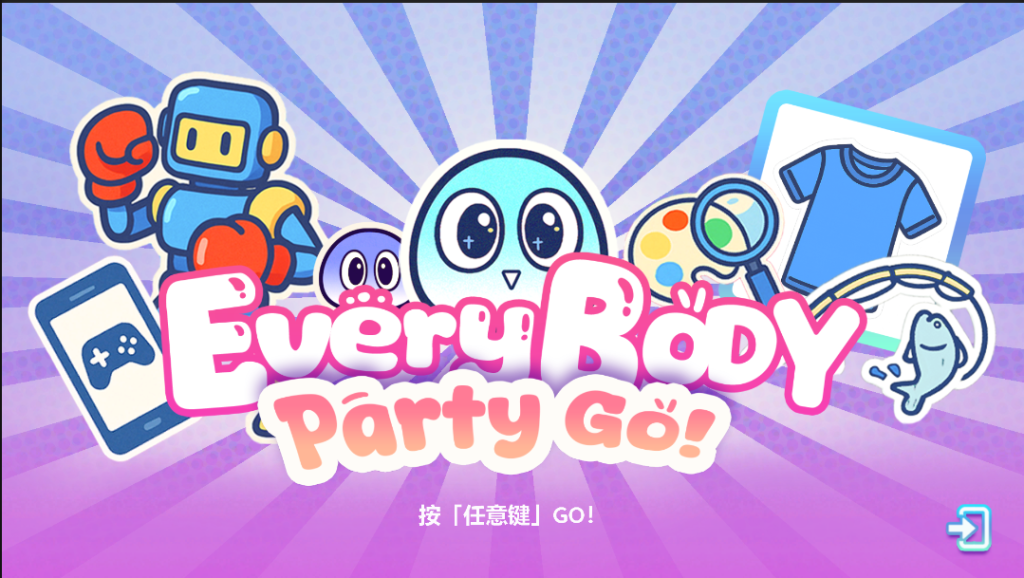
EVERYBODY PARTY GO! -- 一起来派对!
Everybody Party Go! is a multiplayer party game collection designed with an extremely low barrier to entry. Unlike traditional party games, players can simply scan a QR code with their phones to join a room and use their phones as controllers while playing together on a shared screen. The mini-games also make use of mobile features such as the gyroscope and camera to create unique interactive experiences. Our team consisted of two client programmers, one backend programmer, and four game designers (one of whom also worked part-time as an artist). In about two months, we completed the game’s concept development, design, implementation, and testing. During the two-day playtest event, Everybody Party Go! became one of the most played minigames, and we were honored to receive the Gold Prize and the Best Popularity Award at the Kepler Minigame program organized by Tencent. Below is one of our early promotional videos; the final version further improved the UI and overall in-game presentation based on this build.
GAME DESIGN 游戏设计
Our team loves party games, but we often found that offline play is limited by the number of controllers. For example, Overcooked! 2 on PC supports only four players and requires four controllers, which makes it difficult for larger groups to join.
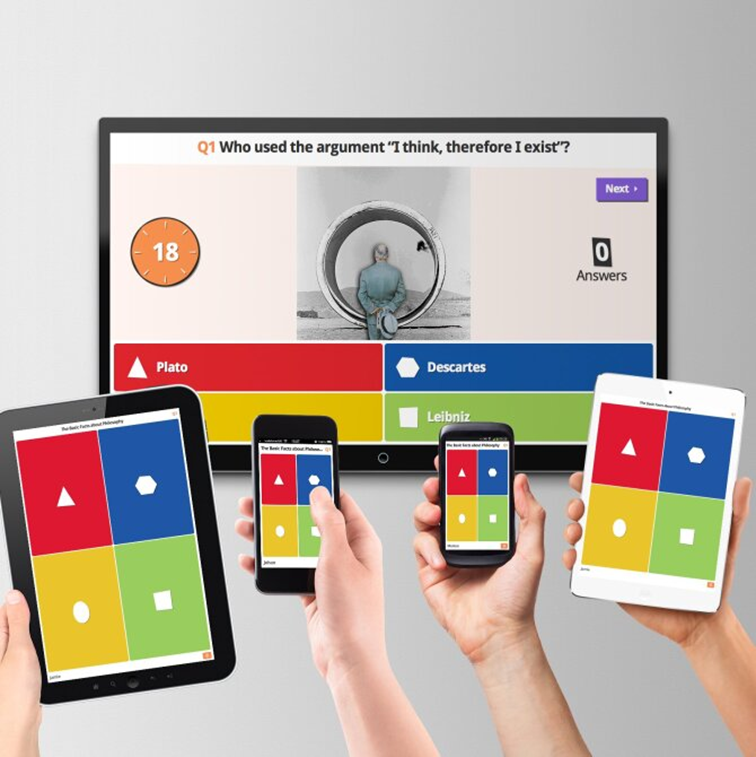
To solve this problem, we explored using smartphones as controllers. Inspired by Kahoot, where players join a room with a PIN and interact through their phones, we adopted a similar approach in Everybody Party Go!. Players can simply scan a QR code to join and play on a shared screen without downloading an app, greatly lowering the barrier to participation.
We also focused on special interactions. Smartphones already include sensors such as microphones, gyroscopes, accelerometers, and cameras, making them an ideal platform for creative control methods like motion, sound, and camera-based input.
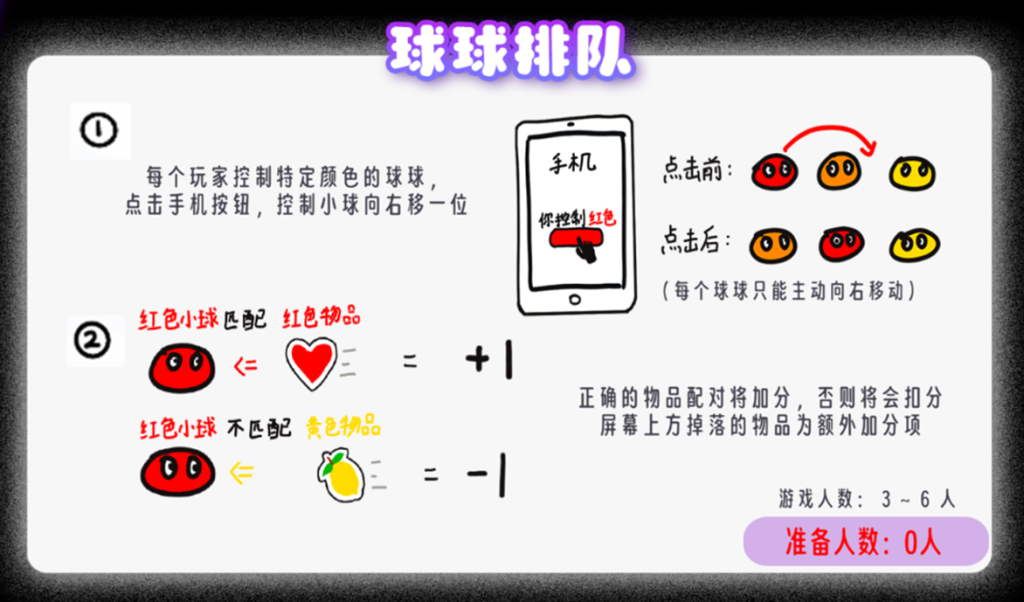
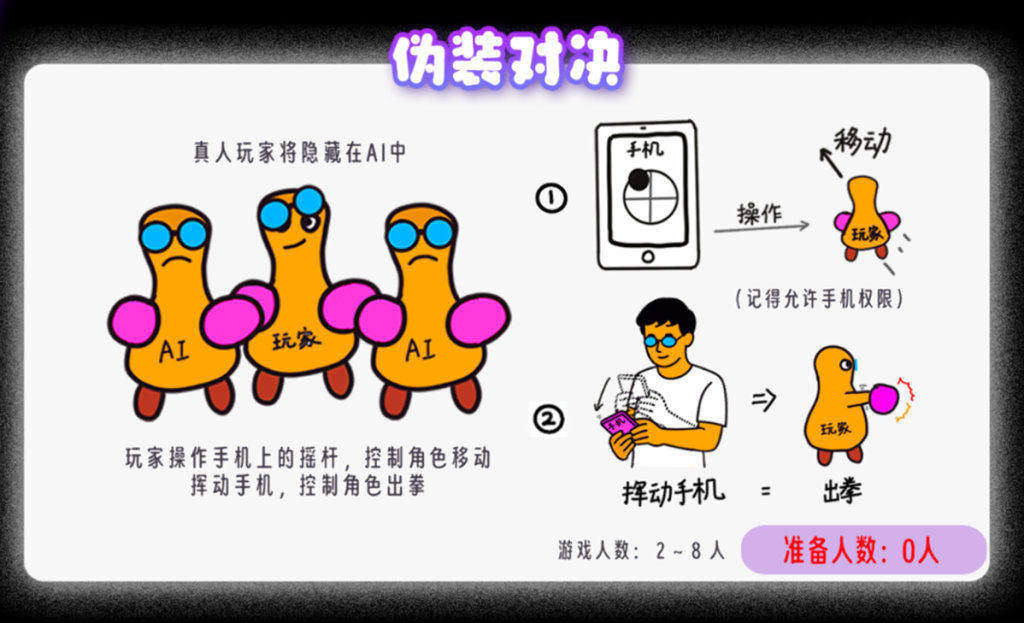
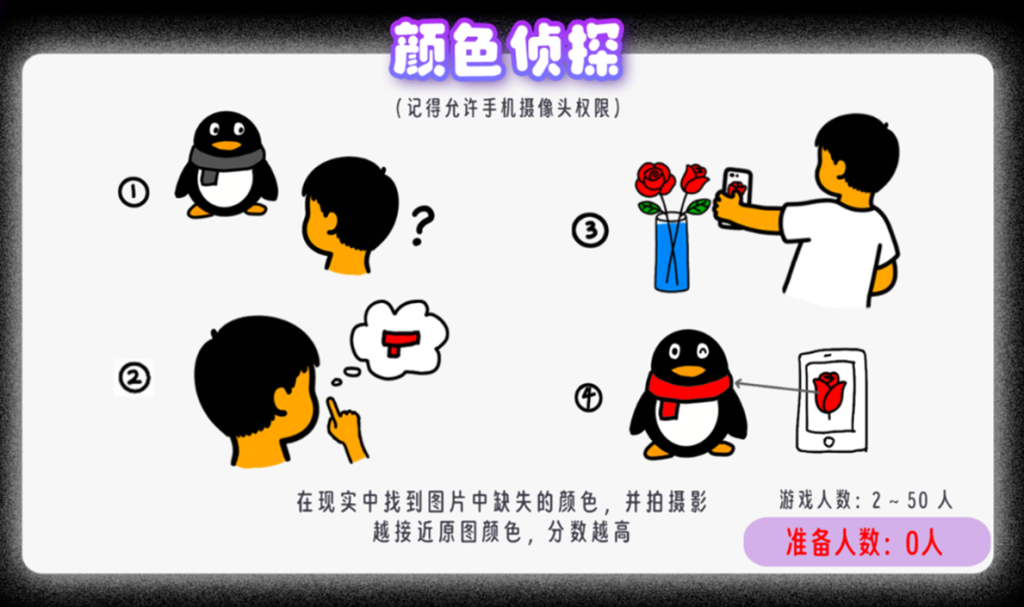
Based on this idea, we developed three mini-games. Ball Queue grew out of our early technical prototype and emphasizes chaotic teamwork and communication. Color Detective is a casual game that can support hundreds of players and integrates real-world color recognition through a loop of recognition, judgment, and verification. Disguise Duel, inspired by Unspottable, offers deeper competitive gameplay and became the most replayed game during the playtest.
Together, the three mini-games cover cooperative, competitive, and casual play styles. Their controls range from simple touch inputs to gyroscope and camera interactions, while the rules remain easy to learn — players can understand each game in about half-minute and quickly join the party.
implementation 技术实现
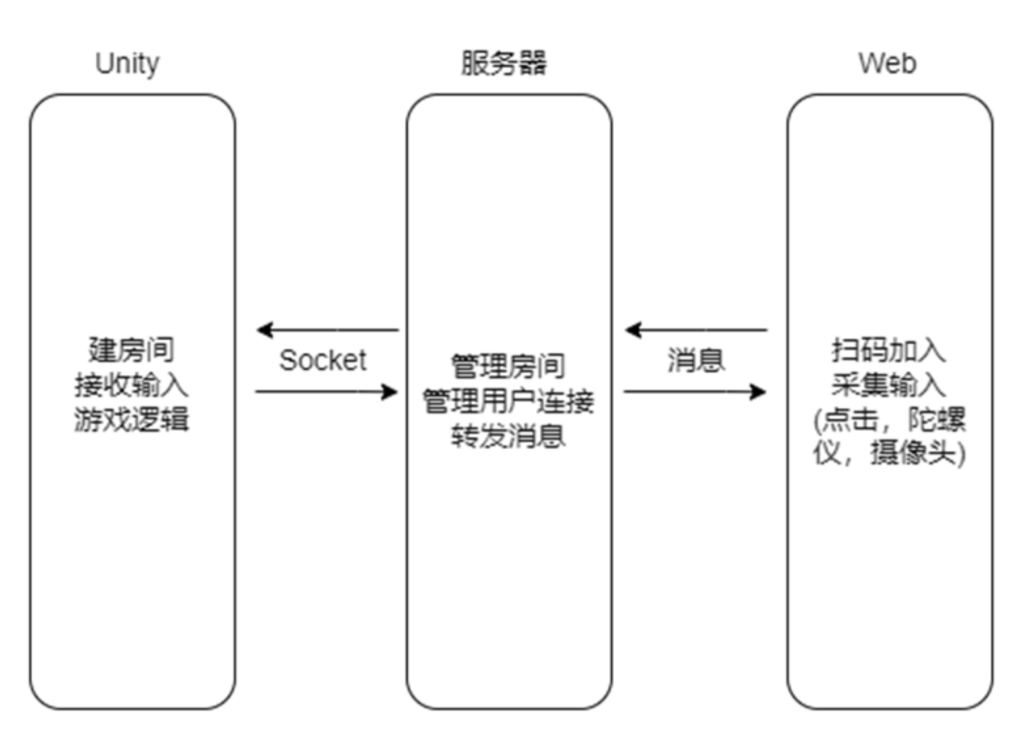
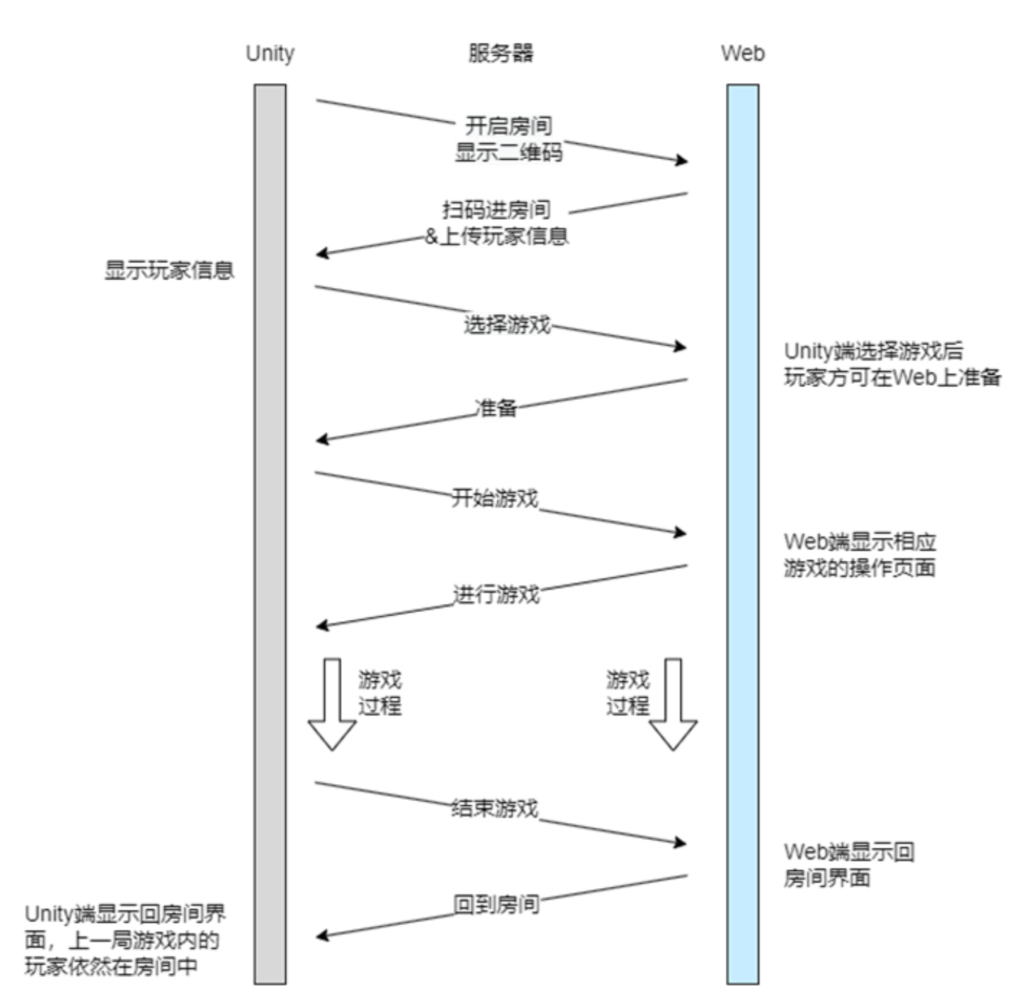
Compared with traditional video game development, the development of Everybody Party Go! was divided into three main parts: the Unity client, the server, and an H5 web interface. The client was also designed so that different mini-games could be developed independently. This structure had a natural advantage—very low coupling between components, allowing different parts of the project to be developed in parallel. Since each mini-game was relatively small in scope, our development progressed quite quickly. Within the first two weeks, we had already completed the core gameplay flow of the entire project. Special thanks go to our amazing artist—although officially part of the operations team, they produced high-quality art assets, UI, and posters for us while still working their regular job. In the final week, we built and tested a new version every day, identifying bugs and fixing them the next day. However, this unconventional development approach also brought its own challenges. The H5 web interface often behaved differently across various phones and browsers, leading to many device-specific bugs. In addition, we encountered timing issues when sending and receiving messages between different platforms. Fortunately, our programmers were incredibly capable and managed to solve these problems one by one.
Summary 总结
Overall, our team’s experience throughout the Minigame project went quite smoothly. Looking back, there are a few points that I personally feel were especially important:
Great team chemistry: Everyone on our team genuinely enjoys party games. When forming the team, we quickly realized we shared similar interests and all wanted to create a party game with unique interactions that people could experience together. Even before the Kepler program began, we had already met several times for meals and discussions, which helped us build strong rapport. Later, when we were working full-time on the project, communication within the team was effortless.
A suitable project direction: Our idea—a collection of mini-games focused on special interactions—had relatively low development costs while offering a fresh experience for most players. This made it especially suitable for a short development cycle.
Clear roles and solid planning: Because the different components of the project were loosely coupled, team members could divide responsibilities effectively. In addition, our PM did an excellent job planning and overseeing the development process, which helped keep our workflow efficient.
Active promotion: During the playtest event, our extremely outgoing operations teammate actively invited players and judges to try the game, bringing a lot of attention and exposure to our project.
From the very beginning, our team shared a simple goal: to have fun, both during development and through the game itself. In fact, the only “serious” request we ever made was not to be eliminated during the mid-term review. Thankfully, we achieved that goal—and much more. I’m grateful to myself and to all of my teammates for making it happen.